On WhatsApp, your marketing doesn't compete with other brands. It sits between the family group chat, a voice note from a friend and a meme someone forwarded at lunch. That's why WhatsApp marketing that copies your email funnel tends to fall flat, and why the brands doing it well behave like a welcome guest rather than an advert.
At Meta's WhatsApp Business Summit 2026 (EMEA), held in Berlin and replayed online on 27 October 2026, Laia Abellan, who leads Meta's Creative Shop in Central Europe, called this "the culture of chat". We watched her session and the rest of the summit, and this post sets out what we learnt, including the Lay's second-screen campaign, and how to use it in your own business.
The short answer. WhatsApp is a high-trust, personal space that people open around 30 times a day, and Meta treats it as an earned channel. Brands win there by joining conversations people already have, speaking the language of chat (humour, stickers, voice notes, creators) and adding value in every message[1].
Why WhatsApp marketing is different: you're in the inner circle
Meta's experts were blunt about the competition. You're not competing with other brands. You're competing with the most intimate relationships in someone's life.
They pointed to research showing 75% of adults want to talk to businesses the same way they talk to friends and family, and noted that people open WhatsApp around 30 times a day[1].
That intimacy cuts both ways. Meta described WhatsApp as an earned channel, not an open one
, and said it rewards quality messages while using signals to prevent spam. Laia's warning was memorable: There is no second opportunity.
Add noise to someone's inbox and you're not gonna get invited twice
.
If your current approach is mostly broadcasts, our piece on why WhatsApp broadcasts hold businesses back explains the cost.
Start from the conversation that's already happening
Laia's first rule was to Originate from that culture that is already happening
. People already plan trips with friends on WhatsApp, ask each other what to wear, send grocery lists to whoever is near the shop, talk about money and decide what to have for dinner. Meta says people also share 4.5 billion reels in conversations every day, each one the start of a chat[1].
The question for your brand isn't "what do we want to say?" but "which of these conversations could we usefully join?" A travel brand can meet a customer on landing with help finding their luggage. A grocer can be part of the shopping list. A retailer can help settle the dress-code debate.
The Lay's lesson: own a second-screen moment
The standout example was Lay's. Laia explained that the brand tapped into an already existing occasion and cultural moment, which is watch parties
: the second-screen habit of messaging friends while a match is on TV.
- The idea: "The Most Epic Group Chat", a celebrity group chat on an "Epic Watch Party" WhatsApp Channel. The slides showed David Beckham, Lionel Messi and Steve Carell trading jokes, emojis and voice notes, exactly the way friends do during a game.
- The mechanics: a WhatsApp bot, plus games and promotions built with WhatsApp Flows.
- The scale: it ran in 30 countries and launched a new WhatsApp Channels feature, admin profiles[1].
You don't need football legends to borrow the idea. The lesson is to find the moment when your customers are already on their phones talking about something you're part of, and show up in that moment with something worth sharing.
Fenty Beauty: discovery that feels like chatting with a friend
Laia's second example was Fenty Beauty's Rose Amber, an AI beauty advisor on WhatsApp that helps people find the right lip shade. Inside the chat, customers can take a quiz or simply ask questions, and the conversation weaves in rich media, voice notes and creator demos[1].
Just as important was what happened before the chat. Many brands, Laia said, focus on building the experience and forget that someone needs to get into the chat
. Fenty teased the conversation with ads that click to WhatsApp and with creators, so people knew what to expect before they tapped.
Speak the grammar of chat
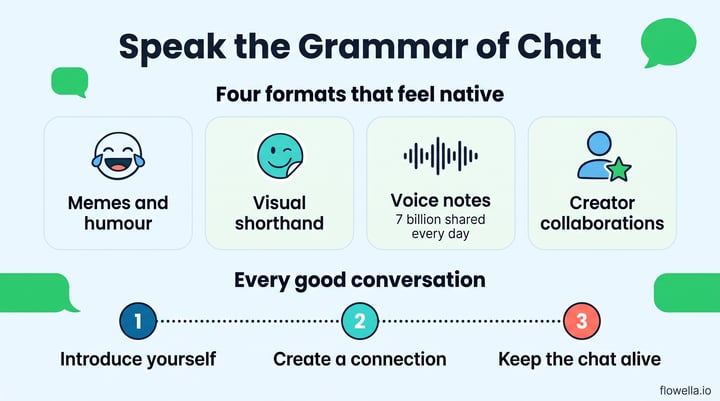
Laia set out the formats that make a brand feel native to WhatsApp:
- Memes and humour. It's how people talk to each other now, even about serious topics.
- Visual shorthand. Stickers and images say a lot in little space, and help where reading is harder.
- Voice notes. Meta says 7 billion are shared on its platforms every day[1].
- Creator collaborations. If you already work with creators elsewhere, bring them into the chat.
She also broke every good conversation into three parts: introduce yourself with personality, create a connection by showing you're listening, and keep the chat alive by adding value each time. We explored the trust side of this in from first message to loyal customer.
How to use the culture of chat in your WhatsApp marketing
- List the conversations your customers already have. Write down five moments where they'd naturally message friends about your category, such as booking a trip, choosing a course or planning a party.
- Pick one second-screen moment. Match days, live events, product drops, results day, a webinar or a sale launch all give people a reason to be in the chat at the same time.
- Write an opener with personality. Say who you are, why they're hearing from you and what's in it for them, in the tone a friend would use.
- Make the interactive part a Flow. Quizzes, games, preference questions and sign-ups all work as WhatsApp Flows. With Flowella, a Flow can be built from a HubSpot form, so every answer lands in your CRM ready for a more personal follow-up.
- Use rich media and creators. Put images or video in your template headers (here's how) and invite creators into the conversation.
- Test small, then scale. Send to an engaged segment first and watch replies, blocks and your WhatsApp quality rating before going wide.
WhatsApp marketing and the culture of chat: frequently asked questions
What does Meta mean by the culture of chat?
It's the informal, personal way people use WhatsApp with friends and family: humour, stickers, voice notes and constant small conversations. Meta's advice is for brands to fit into that culture rather than copy email or SMS marketing[1].
What did Lay's do on WhatsApp?
Lay's ran "The Most Epic Group Chat", a celebrity watch-party conversation on a WhatsApp Channel during football, with a WhatsApp bot and Flow-based games and promotions, across 30 countries[1].
How do I stop WhatsApp marketing feeling like spam?
Only message people who opted in, join conversations they already care about, keep every message useful and personal, and watch your quality rating. Meta says it rewards quality and uses signals to prevent spam[1].
Earn the invitation
The summit's creative message was simple: WhatsApp isn't a media placement, it's someone's inner circle. Join the conversations your customers already have, find your own second-screen moment, and use Flows to make the interaction easy. Do that well and you'll be invited back.
References
- Meta: WhatsApp Business Summit 2026 EMEA, on-demand sessions (watched 27 October 2026)
- Meta for Developers: WhatsApp Flows overview
Make your next campaign a conversation
Flowella turns your forms into WhatsApp Flows for quizzes, sign-ups and bookings, with every answer saved to your CRM.