SMS has been the default for booking confirmations, delivery updates and login codes for twenty years. It is short, plain and increasingly expensive, and fraudsters know how to exploit it. At Meta's WhatsApp Business Summit 2026 (EMEA), two companies explained how they moved from SMS to WhatsApp at scale: Flix for passenger updates, and Delivery Hero for one-time passcodes[1].
We watched the Berlin sessions in the online replay on 27 October 2026. This post covers what each company changed, the results they shared on stage, and a step-by-step plan for running the same switch in your business, with SMS kept as a managed fallback.
The short answer. Move the messages customers already expect from you first: confirmations, reminders and passcodes. Flix saw 95% of passengers choose WhatsApp over SMS at checkout and cut its cost per message by 73% compared with SMS. Delivery Hero moved passcodes after fraud-driven SMS cost spikes, and judges each channel on the cost of a successful login, not the price of one message[1].
How Flix moved passenger updates from SMS to WhatsApp
Andrea Brunello, Product Strategy Manager at Flix, described a model that worked well in Europe and North America: email or SMS for three kinds of message. Transactional messages carried the ticket and booking confirmation, operational messages covered delays and cancellations, and marketing handled offers and campaigns.
When Flix launched in India, that model fell flat. So the team asked passengers directly, inside the booking process, how they wanted trip updates: SMS, WhatsApp, email, push notification or something else. India strongly preferred WhatsApp, and Brazil, Chile and Mexico showed high demand too. In Andrea's words, So what we did was basically listen to them
[1].
Flix now lets passengers choose WhatsApp or SMS at checkout. On WhatsApp, a booking confirmation can be longer and clearer, with bold text, emoji and buttons, and a reminder arrives 12 hours before the trip. As Andrea put it about SMS length limits, WhatsApp doesn't have these limitations.
Flix then extended the channel to marketing, automated campaigns and customer service.
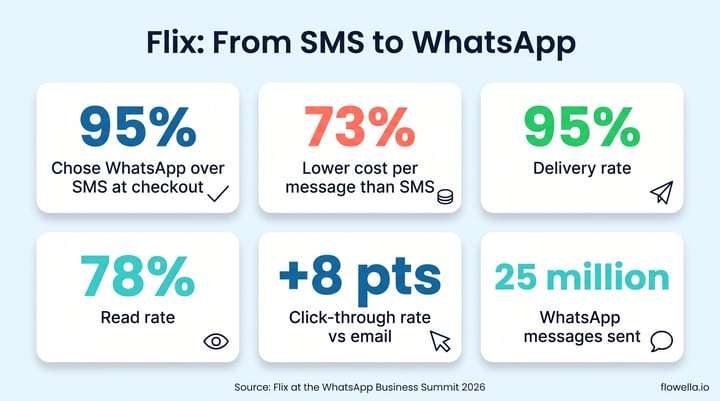
The results Flix shared
| Measure | Flix result |
|---|---|
| Passengers choosing WhatsApp over SMS at checkout | 95% |
| Cost saving per message, compared with SMS | 73% |
| Delivery rate | 95% |
| Read rate | 78% |
| Click-through rate, compared with email | +8 percentage points |
| Messages sent on WhatsApp | 25 million |
Source: Flix's results slide at the WhatsApp Business Summit 2026 (EMEA)[1].
Why Delivery Hero moved one-time passcodes to WhatsApp
Florian Vorwerk, Director Global Operations at Delivery Hero, admitted that authentication is more of a utility and not very sexy topic
. It became urgent when the company saw SMS cost spikes driven by fraud in Southeast Asia and other markets. Fraud, he said, is a constant chase: So you close one door, they find another opening
[1].
Delivery Hero did not switch everywhere at once. It identified the markets with the biggest cost and conversion problems, then ran pilots with the local teams. Five years ago, getting a passcode on WhatsApp felt awkward to many users. The pilots showed good delivery, better authentication conversion and, as the cherry on top, lower cost. On the same panel, Meta's Victoria Canduela Ruiz said WhatsApp has proven stronger than SMS for passcodes, with a 98% delivery rate.
Meta made the same move for its own apps. The summit's case-study reel said prioritising WhatsApp over SMS for passcodes raised account recovery success by 20% on Instagram and 11% on Facebook[1]. On WhatsApp, these codes go out as authentication templates, which can include one-tap autofill on Android[2].
Florian's three lessons for an OTP switch
- Know your markets. WhatsApp coverage and customer expectations vary by country. Where it is already the everyday app, adoption comes quickly.
- Centralise your set-up. If different teams send passcodes through different providers, you cannot run one strategy. Decide your primary channel and your fallbacks, and manage them centrally, or you get
a free-for-all on all the other channels
. - Count cost and conversion together. A channel can look cheaper per message yet need two or three attempts before a code gets through. That costs more and gives a worse experience.
His final point applies to every business: the login screen is often the first thing a customer sees. if that experience is bad, no matter what you have afterwards, doesn't matter
.
SMS to WhatsApp: what changes for your customers
Meta's own forecast points the same way. A slide in Max Motta's customer service session quoted Gartner: by 2028, advanced rich messaging overtakes SMS for customer service[1]. Here is what the switch changes in practice.
| What matters | SMS | |
|---|---|---|
| Format | Short plain text, length limits | Longer messages, bold text, images, buttons |
| Next step | A link out to a website | Buttons and WhatsApp Flows inside the chat |
| Replies | Often a no-reply number | A two-way thread the customer already uses |
| Sender trust | A number or short code | Your business name and profile |
| Cost | Per message, plus retries when codes fail | Per delivered message, by category and country[4] |
SMS still has a job. Not every customer uses WhatsApp, so keep it as the managed fallback rather than the default. And the move only works if you hold WhatsApp numbers for your customers; our post on how many WhatsApp numbers your CRM holds explains why that matters.
How to use this in your business
Here is a practical plan for moving from SMS to WhatsApp, based on what Flix and Delivery Hero did.
- Audit your SMS by type. Split last quarter's volume into transactional, operational, passcodes and marketing, with the cost of each.
- Ask your customers. Add a simple channel choice at checkout or sign-up, as Flix did, and record WhatsApp consent in your CRM.
- Move utility messages and passcodes first. These are messages customers already expect, so they build trust in the new channel. Start in the markets where SMS is most expensive or most abused. Flowella can send order and shipping updates from your CRM and one-time passcodes through its API[5][6].
- Design for the richer format. Add a button or a WhatsApp Flow for the obvious next step, such as rescheduling or confirming details, so the answer lands in your CRM.
- Write your fallback rules. Decide when a failed WhatsApp message falls back to SMS, after how long, and how many times. Keep one owner for the rules.
- Measure cost per outcome. Track cost per confirmed booking or per successful login, not cost per message. Meta charges per delivered message, so check the rates for your countries[4][7].
If your emails and texts are going unanswered, our look at why 73% of consumers prefer messaging covers the wider shift.
SMS to WhatsApp: frequently asked questions
Is WhatsApp cheaper than SMS?
Often, but it depends on your countries and message types. Flix reported a 73% cost saving per message compared with SMS. Meta charges per delivered WhatsApp message by category and country, so compare your own SMS bill, including retries, with Meta's published rates[1][4].
Can I send one-time passcodes on WhatsApp?
Yes. Passcodes go out as authentication templates, which support copy-code and one-tap autofill buttons[2]. Delivery Hero and Meta both moved passcodes from SMS to WhatsApp.
Should I stop sending SMS altogether?
No. Keep SMS as a managed fallback for customers who do not use WhatsApp or when a message fails. The key, as Delivery Hero found, is one clear primary channel and fallback rules you control centrally.
Which messages should move first?
Booking and order confirmations, reminders, delivery updates and passcodes. Customers expect them, they are sent as utility or authentication messages, and they prove the channel before you add marketing[3].
Make WhatsApp the primary channel, and manage the fallback
The lesson from the summit is that moving from SMS to WhatsApp is less about technology than about choices: ask customers which channel they want, move the expected messages first, and measure what each successful outcome costs. Flix listened to its passengers and cut message costs by 73%. Delivery Hero treated passcodes as a strategy, not a commodity. Start with one message type in one market, and keep SMS for the cases that need it.
References
- Meta: WhatsApp Business Summit 2026 EMEA, on-demand sessions (Flix, the Delivery Hero panel and Max Motta, "Transforming customer service on WhatsApp")
- Meta: One-tap autofill authentication templates
- Meta: Utility templates
- Meta: Pricing on the WhatsApp Business Platform
- Flowella Knowledge Base: Send WhatsApp order and shipping updates from HubSpot
- Flowella Knowledge Base: Send one-time passcodes over WhatsApp with the Flowella API
- Flowella Knowledge Base: WhatsApp pricing categories and how Flowella counts usage
Move your first SMS journey to WhatsApp
Send confirmations, reminders and updates on WhatsApp from your CRM, and turn the next step into a WhatsApp Flow.