For years, good marketing could cover the gap between what a brand promised and what it delivered. Agentic commerce closes that gap. When an AI agent shops on your customer’s behalf, it compares your price, stock and delivery promise line by line, and it remembers when you fall short. That was the warning from Accenture at Meta’s WhatsApp Business Summit 2026 (EMEA), held in Berlin with an online replay on 27 October 2026[1].
We watched every session. This article explains what agentic commerce is, how far customers already trust AI to act for them, the three things agents do to your brand, and the practical steps that get your business ready, including where WhatsApp fits.
The short answer. Customers are handing research and comparison to AI, and more of them are handing over decisions. Agents will break your offer into parts, test your claims against evidence and keep reassessing whether you are still the best fit. Accenture’s advice was to make product, price, availability and claims readable by machines, close the gap between promise and delivery, and stay in the conversation with your customers[1].
What is agentic commerce?
Agentic commerce is buying and selling where AI agents do part of the work: researching options, comparing products, recommending a choice and, in some cases, completing the purchase for a person. On the business side, agents answer questions, recommend products and take orders inside channels such as WhatsApp.
The scale is large. Elie Antoun, Enterprise Technical Sales Manager at Meta, cited McKinsey’s estimate that agentic commerce transactions will reach between three and five trillion dollars by 2030[1]. Meta also reports that more than one million businesses already use Meta Business Agents on WhatsApp and Messenger[2].
Customers are ready for it. Alon Ozery, Product Marketing Manager at Meta, shared Forrester research for Meta: 74% of people are comfortable using AI to interact with brands, and 62% would turn to a generative AI chat before any other channel[1].
Customers already delegate to AI, up to a point
Accenture’s Dominik Hennecke and Pia Steinhoff started with a problem digital commerce never solved. Shoppers have endless choice, and the effort of deciding lands on them: 85% of consumers are likely to abandon a purchase because of frustration, indecision or an over-complex journey.
So people are asking AI for help. Accenture’s research, presented at the summit, shows a spectrum of trust[1]:
- 74% would delegate task execution: research, comparison and finding options.
- 32% would delegate decisions within their own constraints.
- 9% are open to full autonomy, where the agent decides and transacts.
Two details matter for planning. First, delegation varies by category. People happily hand over chores such as insurance and utilities, while in travel one respondent said of the hotel, the view and stuff I like to select by myself
. Second, trust dips at the moment of payment: when money moves, they still want to have their hand on the wheel
. After the purchase, willingness to delegate rises again for loyalty and customer service.
The bar for experience has also moved. Among people who use AI weekly, 64% say they feel heard, seen, and understood
, and Pia Steinhoff called feeling understood the new baseline for customer interaction[1].
Agentic commerce exposes the gap: decompose, verify, reassess
Pia Steinhoff’s most uncomfortable point was that brands have been able to hide a multitude of sins
behind beautiful pictures and claims. Not anymore, because agents will surface all of that.
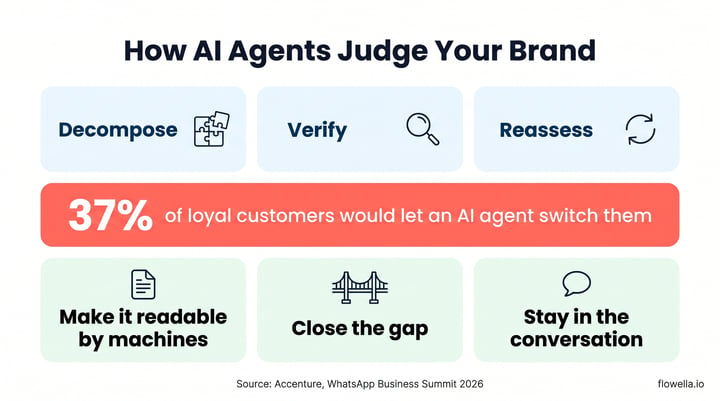
She described three behaviours:
- They decompose. Agents break your brand into comparable parts, such as price, specification, availability and service, and compare each one.
- They verify. Claims get tested against evidence. If your marketing and your operations disagree, the agent finds out.
- They reassess. Loyalty is no longer one decision held by habit. An agent keeps checking for a better fit in the background.
The loyalty finding is the one to share with your leadership team. In Accenture’s research, 37% of behaviourally loyal consumers, your good customers, would let an AI agent switch them away from a preferred brand if it found a better fit[1].
| Area | Before agents | With agents in between |
|---|---|---|
| Visibility | Keywords, metadata and page structure to rank in search | Product, pricing and availability structured so an agent can read them |
| Marketing | Persuade a person with creative and campaigns | Campaigns still win attention, then the most verifiable claim wins the recommendation |
| Loyalty | Habit, switching costs and points programmes | A continuous better-deal check running in the background |
Source: Accenture’s session at the WhatsApp Business Summit 2026[1]. As Pia Steinhoff put it, if the agent can’t parse you, it won’t recommend you
. Brand still matters: 56% of consumers would tell their agents which brands to consider, but after that, it’s the most verifiable claim that will win.
Where WhatsApp fits in agentic commerce
Accenture closed with a three-part line:earn the human, earn the agent, and stay in the conversation
. WhatsApp is where that conversation increasingly happens, and where agents are starting to meet.
- Agents on both sides. Max Koziolek of Charles, a Meta partner, expects consumers’ own AI agents to message brands’ WhatsApp agents within two years, with
AI agents on both sides
. - It is already happening. Hendrik Wittrock of Delivery Hero described its restaurant advisor agent meeting a restaurant’s own ordering agent in WhatsApp, the two
basically arguing with each other
. - The relationship continues after purchase. That is where Accenture found willingness to delegate rises again, and where a WhatsApp thread with useful updates and fast answers keeps you in the running.
The conversation is also where you learn what each customer actually needs. Captured as free text, that knowledge is hard to use. Captured as structured answers through WhatsApp Flows, it becomes first-party data your CRM can act on, and data you can prove[3].
How to use this in your business: get ready for agentic commerce
- Audit your claims against your operations. List the promises in your marketing, such as next-day delivery, in stock or best price, and check them against what actually happens. Close the gaps before an agent finds them.
- Make product, price and availability machine-readable. Keep feeds, catalogues and website product data structured, consistent and current, so an agent reading them gets the same answer a person would.
- Capture preferences as structured data. Use a WhatsApp Flow to ask the questions that define fit, such as budget, size, location or timing, and send the answers to your CRM as clean fields. Our guide to creating Flows from your existing forms shows how, and each completed Flow appears on the contact’s activity timeline.
- Stay in the conversation after purchase. Order updates, delivery windows and service answers on WhatsApp are where customers are most willing to let an assistant help, and where loyalty is now decided.
- Keep the website, add the conversation. In the summit Q&A, Meta’s advice was to
keep the app, keep the web, just stop assuming they’re the only doors.
Treat chat as another funnel and compare the returns.
If your leads stall before they buy, the decision problem Accenture described is probably part of it. We looked at that in you have plenty of leads, so why aren’t they buying?
Agentic commerce: frequently asked questions
What is agentic commerce?
It is commerce in which AI agents research, compare, recommend and sometimes buy on a person’s behalf, while businesses use agents to answer and sell. McKinsey, cited by Meta at the summit, expects three to five trillion dollars of agentic commerce transactions by 2030[1].
Do customers trust AI agents to buy for them?
Partly. Accenture’s research found 74% would delegate research and comparison, 32% would delegate decisions and 9% would give an agent full autonomy. Trust dips when payment happens and rises again after purchase[1].
Will AI agents replace my website?
Not according to Meta. Its advice was to think of chat as another funnel, run it alongside your website and app, and follow the returns[1].
What should a business do first?
Check that your claims match your operations, then make product, price and availability data structured and current. Those two steps help with both human customers and agents.
Earn the human, earn the agent
Agentic commerce does not make brand irrelevant, but it makes it checkable. The businesses that win will keep their promises, publish data machines can read, and stay in the conversation after the sale. Customers already prefer messaging to email, so WhatsApp is a natural place to start. See how Flowella works with HubSpot to turn your forms into WhatsApp Flows that capture structured, provable data.
References
- Meta: WhatsApp Business Summit 2026 EMEA, on-demand sessions (online replay, 27 October 2026)
- Meta Newsroom: Be There for Every Customer With Meta Business Agent (June 2026)
- Meta: WhatsApp Flows overview
Capture data you can prove
Turn your existing forms into WhatsApp Flows and send structured answers straight to your CRM, on any HubSpot plan.