This is Part 5 of a six-part series exploring the findings of Meta's State of Business Messaging 2026 report and what they mean for businesses using HubSpot and WhatsApp.
In the previous articles in this series, we have explored why consumers prefer messaging, why broadcasts fall short, how structured Flows work in practice, and when to use Flows versus chatbots. Now we will address something the Meta report identifies as foundational to all of it: trust.
Because without trust, none of the rest matters.
Trust is the prerequisite for WhatsApp automation
The Meta report dedicates an entire pillar to trust and legitimacy, and the data is unambiguous: 79.3% of consumers are more likely to message a business when they have confidence that the brand is legitimate.[1]
This is not a secondary consideration. It is the gating factor. Before speed, before convenience, before personalisation, consumers need to feel confident they are communicating with a real, trustworthy business.
The research also found that 74.6% of consumers trust a business more when they can exchange messages with them directly. And 73.8% view messaging as a more private way to interact with a business than email or SMS.[1]
That last point is worth pausing on. Consumers perceive messaging apps as more secure than the channels most businesses still default to. Traditional email and SMS are increasingly compromised by phishing, spoofing and scam messages. WhatsApp, with its end-to-end encryption and verified business profiles, provides visible trust signals that legacy channels cannot match.
The erosion of trust on legacy channels
This trust advantage is not just theoretical. The Meta report documents a real shift: consumers are growing wary of email and SMS for sensitive interactions.
For businesses, this has direct commercial consequences. The report found that 40.4% of consumers prefer to receive one-time passwords and two-factor authentication via messaging rather than email or phone calls.[1] When customers are increasingly cautious about engaging with emails that claim to be from their bank, their insurer or their utility provider, the credibility of the entire communication chain is weakened.
WhatsApp's verified business profiles, marked with a visible green tick, provide an immediate visual signal of legitimacy. When a customer sees that badge, they know the message is from an authenticated business, not a spoofed number or phishing attempt. This matters enormously for high-stakes interactions like payment confirmations, account updates and identity verification.
The end-to-end customer journey
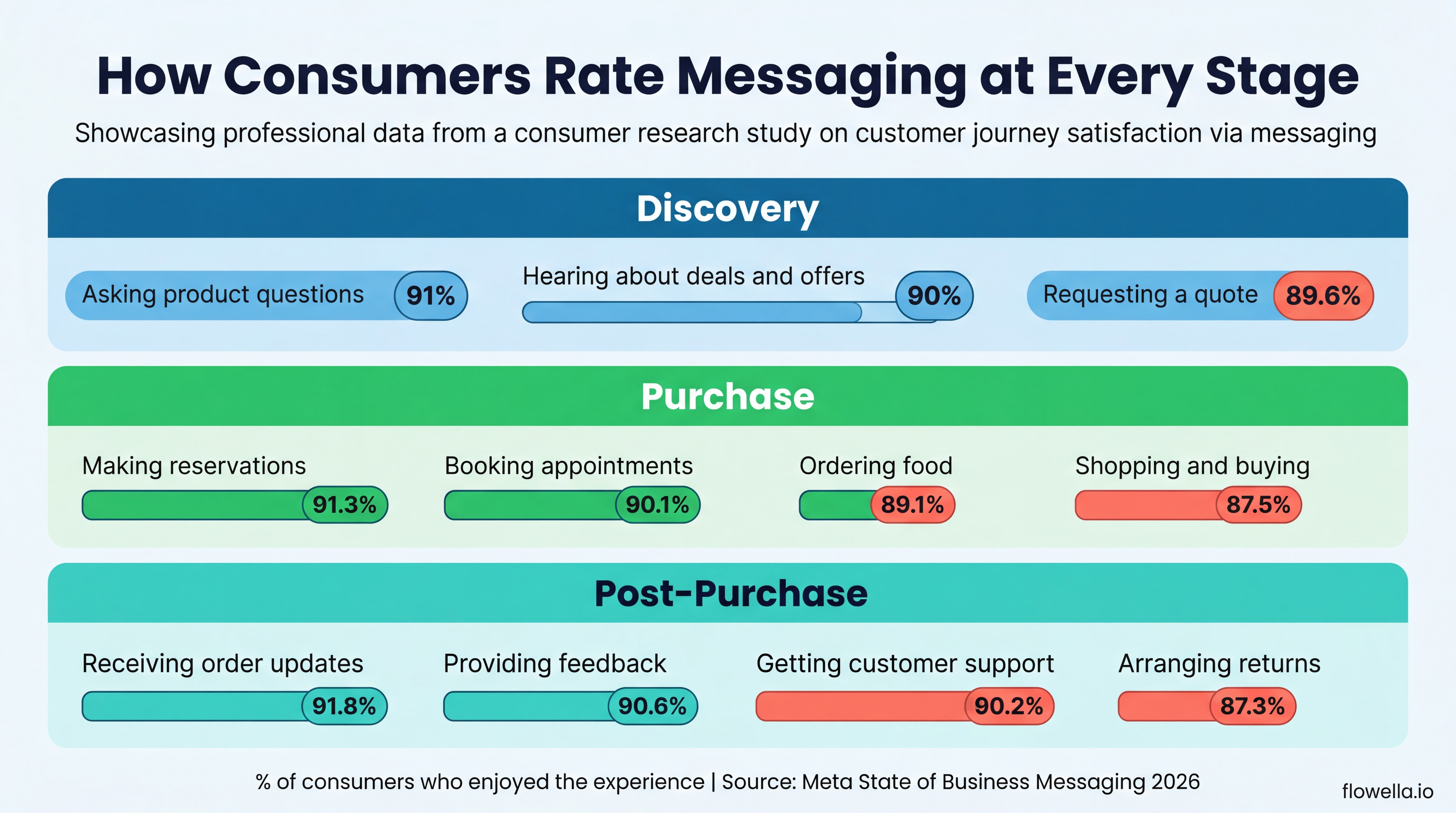
Trust does not just determine whether a customer starts a conversation; it shapes the entire lifecycle. The Meta report maps consumer enjoyment across every stage of the customer journey, and the findings paint a compelling picture of messaging as a unified channel for the complete lifecycle.[1]
Discovery and consideration
At the top of the funnel, consumers are using messaging to research and evaluate. The report shows that 91% of consumers who asked questions about a product via messaging enjoyed the experience. Nearly 90% enjoyed hearing about deals, offers or coupons through messaging. And 89.6% enjoyed requesting a quote.[1]
For businesses using HubSpot, this maps naturally to the lead capture phase. A click-to-WhatsApp ad or QR code on a website can open a conversation. A structured WhatsApp Flow can capture the lead's requirements, preferences and contact details, all as clean HubSpot form submissions that feed into lead scoring and nurture workflows.
Purchase
At the transactional stage, messaging satisfaction remains exceptionally high: 91.3% for making reservations, 90.1% for booking appointments, 89.1% for ordering food, 87.5% for shopping and buying, 86.6% for paying bills.[1]
The report also highlights that 72.4% of consumers are more likely to purchase from brands that offer messaging.[1] This is messaging as a direct revenue driver, not just a support channel.
Post-purchase and re-engagement
After the transaction, messaging becomes the primary channel for service, updates and relationship management. The highest-scoring post-purchase activity? Receiving order updates, at 91.8%. Providing feedback scored 90.6%. Getting customer support and receiving reminders both scored 90.2%.[1]
Even traditionally friction-heavy interactions scored well: arranging a product return (87.3%) and cancelling a subscription (82.3%).[1] When these interactions happen in a channel the customer trusts and prefers, even the difficult conversations go more smoothly.
Connecting the journey in HubSpot
Here is where the structured data approach we have discussed throughout this series becomes strategically powerful. When every touchpoint in the customer journey, from initial enquiry to post-purchase feedback, flows through the same channel and the same CRM, you get something extraordinary: a complete, connected customer record.
With Flowella and HubSpot, each WhatsApp Flow submission is a HubSpot form submission. Each interaction updates the contact record. Each response can trigger the next step in the journey. And because it all happens in the same WhatsApp thread, the customer experiences a seamless, continuous conversation, not the fragmented, channel-switching experience the Meta report identifies as a major source of dissatisfaction. See our HubSpot integration guide for the technical details.
The data also tells us that 42.2% of consumers value being able to preserve conversation history when using a messaging app, and 35.4% value being able to handle all interactions with a business in one place.[1] WhatsApp, by its nature, preserves that conversation thread. Every message, every Flow submission, every interaction is there in the customer's chat history: a running record of their relationship with your brand.
Building memory into messaging
The Meta report makes an observation that applies directly to how businesses should use their CRM: over 75% of consumers want businesses to mimic personal conversations, and that means maintaining context.[1]
In personal conversations, historical context is assumed. You do not re-introduce yourself every time you message a friend. In business communication, that context must be preserved deliberately, and that is exactly what a well-configured CRM does.
When a customer who booked a reservation last month, gave feedback, and mentioned a nut allergy receives a new WhatsApp message that says "Hi Sarah, we have just launched a new spring menu, and yes, we have flagged your nut allergy with the kitchen team," that is the kind of personalisation that builds genuine loyalty. It shows the customer that the business remembers them, values their time and respects their preferences.
This only works when the data from every interaction is captured in a structured, reliable format. A chatbot transcript from three months ago is difficult to mine for this kind of context. A set of clean HubSpot properties (dietary requirements, feedback score, preferred dining time, special occasions) is immediately actionable.
Trust, structured data and the loyalty loop
The Meta report describes a "customer loyalty loop": purchase leads to post-purchase communication, which leads to repeat purchases, which reinforces the cycle. Messaging is the thread that connects each stage.
With Flowella and HubSpot, that loop is powered by structured data at every turn. Each interaction captures clean information. Each piece of information enables smarter, more personalised communication. Each personalised communication builds trust. And trust drives the next transaction.
It is a virtuous cycle, and it starts with the decision to treat WhatsApp not as a broadcast channel, but as a structured data platform that your CRM can learn from.
In the final article of this series, we will get practical: a step-by-step guide to setting up your first WhatsApp workflow with Flowella and HubSpot in under 30 minutes.
References
- Meta / Kantar: State of Business Messaging 2026 (online study of 11,056 adults across 22 global markets, April-September 2025)
Want to see the complete customer lifecycle in action? Book a demo or start your free trial.