This is Part 4 of a six-part series exploring the findings of Meta's State of Business Messaging 2026 report and what they mean for businesses using HubSpot and WhatsApp.
If you have been following this series, you will know that consumers overwhelmingly prefer messaging, that broadcast-style WhatsApp marketing frustrates them, and that structured WhatsApp Flows can power impressive automated journeys.
But there is a question we hear regularly about WhatsApp chatbots: "If they are getting so good, why do we need structured Flows at all? Can't we just let the chatbot handle it?"
It is a fair question. And the answer, drawn from both the Meta report data and our experience building Flowella, is more nuanced than a simple "chatbots are bad." Chatbots are genuinely useful for some things. But they have a fundamental limitation that structured data solves.
What the data says about AI chatbots and WhatsApp
The Meta report is broadly positive about AI in business messaging. The key figures:[1]
- 67.7% of online adults agree that getting a response from an AI chatbot is helpful
- 67.4% agree AI-powered chatbots will be a useful way to get help in the future
- 42.9% say quick responses from a 24/7 AI chatbot would improve their experience when communicating with a business
- 69.0% say waiting on hold is frustrating and a waste of time
The picture is clear: consumers are broadly receptive to AI support. They value always-on availability and fast responses. The days of chatbot scepticism are fading.
But notice the framing. Consumers value chatbots for getting help, quick responses and avoiding wait times. These are support and information retrieval tasks. The chatbot answers a question, solves a problem or directs the customer to the right resource.
That is different from data collection. And that distinction is crucial.
The structured data problem with chatbots
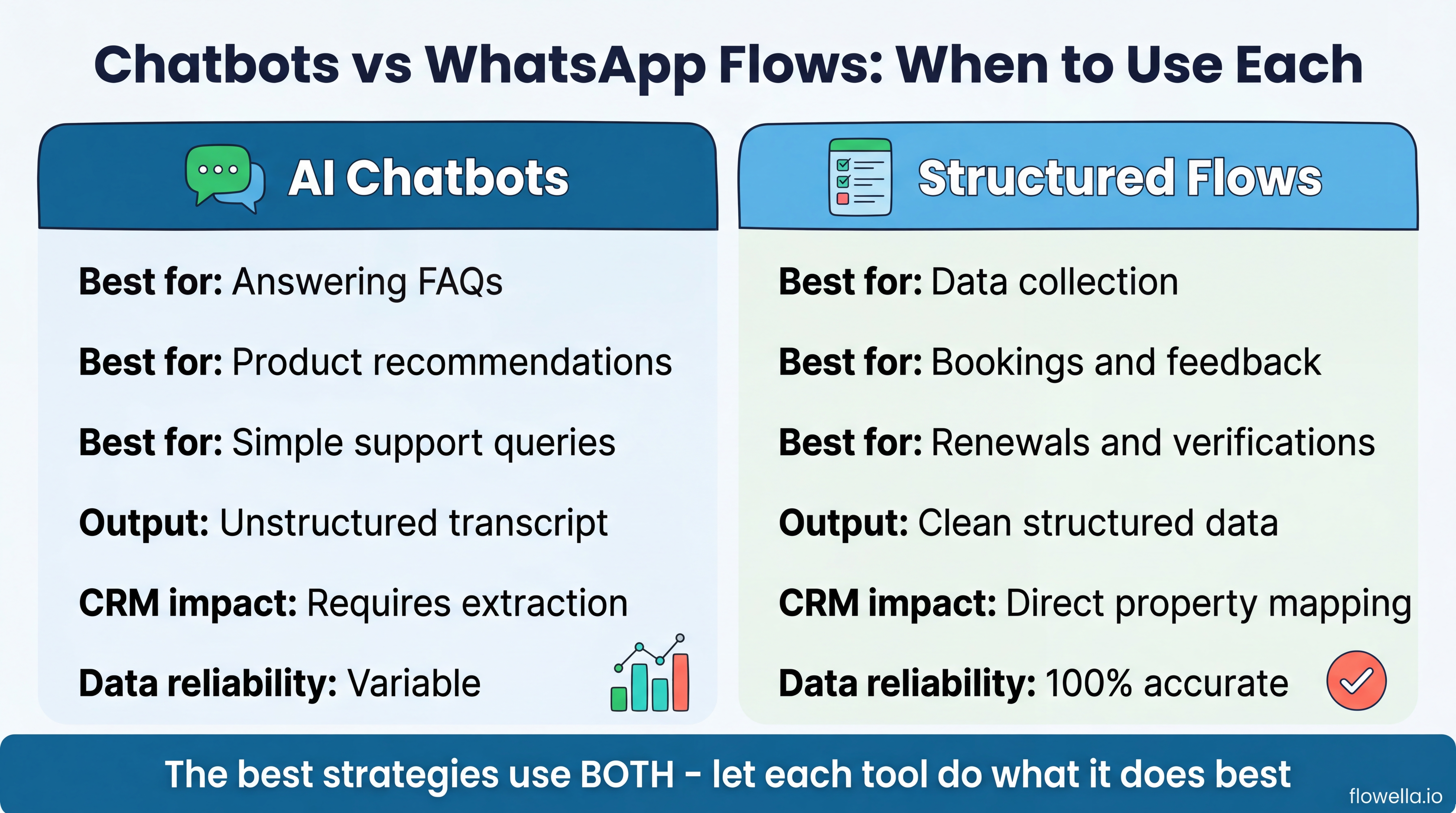
Here is the core issue with relying on chatbots for data capture: a chatbot conversation produces a transcript, not a dataset.
When a customer interacts with even the most sophisticated AI chatbot, the output is natural language text. The chatbot may understand the intent, extract entities and generate a helpful response in real time. But when you need that information to flow into your CRM as clean, structured properties (properties you can filter on, trigger workflows from and report against) you are relying on the chatbot's extraction accuracy.
Consider a simple example. A customer messages a chatbot:
"Hi, I need to update my address. We moved to 14 Willow Lane, Manchester, M20 4BF last month. Oh and my wife's email changed too, she's now jane.smith@newcompany.co.uk."
A good AI chatbot will understand this. It might even confirm the details back to the customer. But behind the scenes, extracting "14 Willow Lane" as the street, "Manchester" as the city, "M20 4BF" as the postcode, and correctly attributing the email to a different contact record (all with sufficient confidence to write directly to your CRM) is a different challenge entirely.
Now compare the same interaction as a WhatsApp Flow:
- Street address: [text field] → "14 Willow Lane"
- City: [text field] → "Manchester"
- Postcode: [validated text field] → "M20 4BF"
- Updating details for: [dropdown] → "Another household member"
- Their email: [email-validated field] → "jane.smith@newcompany.co.uk"
Each field is validated in real time. Each value maps directly to a CRM property. There is no ambiguity, no extraction confidence score, no risk of the wrong field being updated. The data is clean by design.
Helpful is not the same as automatable
This is the distinction that matters most. A chatbot can be helpful, and the data shows consumers appreciate that. But helpful does not mean automatable.
If your goal is to answer customer questions, provide product information or handle simple support queries, a chatbot is an excellent tool. HubSpot's own Breeze Customer Agent is a good example of this done well.
But if your goal is to collect specific information that triggers downstream automation (booking confirmations, feedback scores, renewal decisions, KYC data, dietary requirements, insurance details) then you need the data to arrive in a structured format. That is what WhatsApp Flows deliver.
The Meta report's data on conversational commerce reinforces this. It found that 64% of online adults prefer to make a purchase via messaging rather than going to a physical store, and 42.5% say that shopping in-app would improve their messaging experience.[1] These are transactional activities that require structured inputs: product selection, size, quantity, delivery address, payment confirmation. A chatbot conversation about "I'd like the blue one in medium" is less reliable than a flow where the customer selects "Blue" from a colour dropdown and "M" from a size dropdown.
The hybrid model
The good news is that this is not an either/or choice. The most effective WhatsApp strategies use both, but for different purposes.
Use chatbots for:
- Answering frequently asked questions
- Providing product information and recommendations
- Handling simple support queries
- Qualifying leads through conversation
- Routing complex queries to human agents
Use structured WhatsApp Flows for:
- Collecting data that needs to map to CRM properties
- Capturing feedback and NPS scores
- Processing bookings, appointments and reservations
- Running surveys and data enrichment campaigns
- Handling renewals, confirmations and verifications
- Any interaction where the output triggers an automated workflow
The Meta report itself advocates for this hybrid approach. Its strategy section recommends that businesses "automate high-volume inquiries" with AI chatbots while ensuring "seamless handoffs" for more complex interactions. With Flowella, those handoffs can go in both directions: a chatbot can answer initial questions and then launch a structured Flow when it is time to collect specific data.
What this means for your HubSpot setup
If you are a HubSpot user, think about your current WhatsApp strategy (if you have one) and ask: where am I collecting data, and where am I answering questions?
For the data collection touchpoints (the forms, the surveys, the confirmations, the renewals) Flowella lets you take the HubSpot forms you already have and deploy them as WhatsApp Flows. The data comes back as proper form submissions, populating contact properties and triggering workflows exactly as if the customer had filled in a web form. Except the completion rate is likely to be significantly higher, because the interaction happens in WhatsApp, a channel with ~98% open rates. See our HubSpot integration guide for the technical details.
For the support and information touchpoints, continue using HubSpot's native chatbot capabilities or a dedicated AI solution. Let each tool do what it does best.
In the next article, we will explore how this structured approach enables something the Meta report identifies as increasingly critical: building trust and supporting the entire customer journey from first message to loyal customer.
References
- Meta / Kantar: State of Business Messaging 2026 (online study of 11,056 adults across 22 global markets, April-September 2025)
Want to see how structured Flows compare to chatbot conversations in practice? Start your free Flowella trial or book a demo to see it in action.