This is Part 3 of a six-part series exploring the findings of Meta's State of Business Messaging 2026 report and what they mean for businesses using HubSpot and WhatsApp.
So far in this series, we have covered the consumer shift towards messaging and why broadcast-style WhatsApp marketing falls short. Now let us make it concrete.
In this article, we walk through a complete, real-world example: how a restaurant can use WhatsApp Flows and HubSpot to automate the entire customer experience, from booking confirmation through to post-meal feedback and review generation. No manual work. No messy inboxes. Just structured data driving intelligent workflows.
And the data from Meta's State of Business Messaging 2026 report shows us exactly why this works.
Why hospitality is a perfect fit for WhatsApp restaurant automation
The Meta report includes satisfaction ratings for different types of messaging-based transactions. The hospitality-related figures are extraordinary:[1]
- 91.3% of consumers who made a reservation via messaging enjoyed the experience
- 90.6% enjoyed providing feedback (such as sharing a review) via messaging
- 90.2% enjoyed receiving appointment or event reminders via messaging
- 89.1% enjoyed ordering food via messaging
These are not marginal preferences. These are overwhelming satisfaction rates. And they point to something important: consumers do not just tolerate transactional messaging. They actively enjoy it. Particularly when it is structured, quick and happens in a channel they already use every day.
For restaurants, cafes and hospitality businesses, this is a blueprint for a better customer experience that practically runs itself.
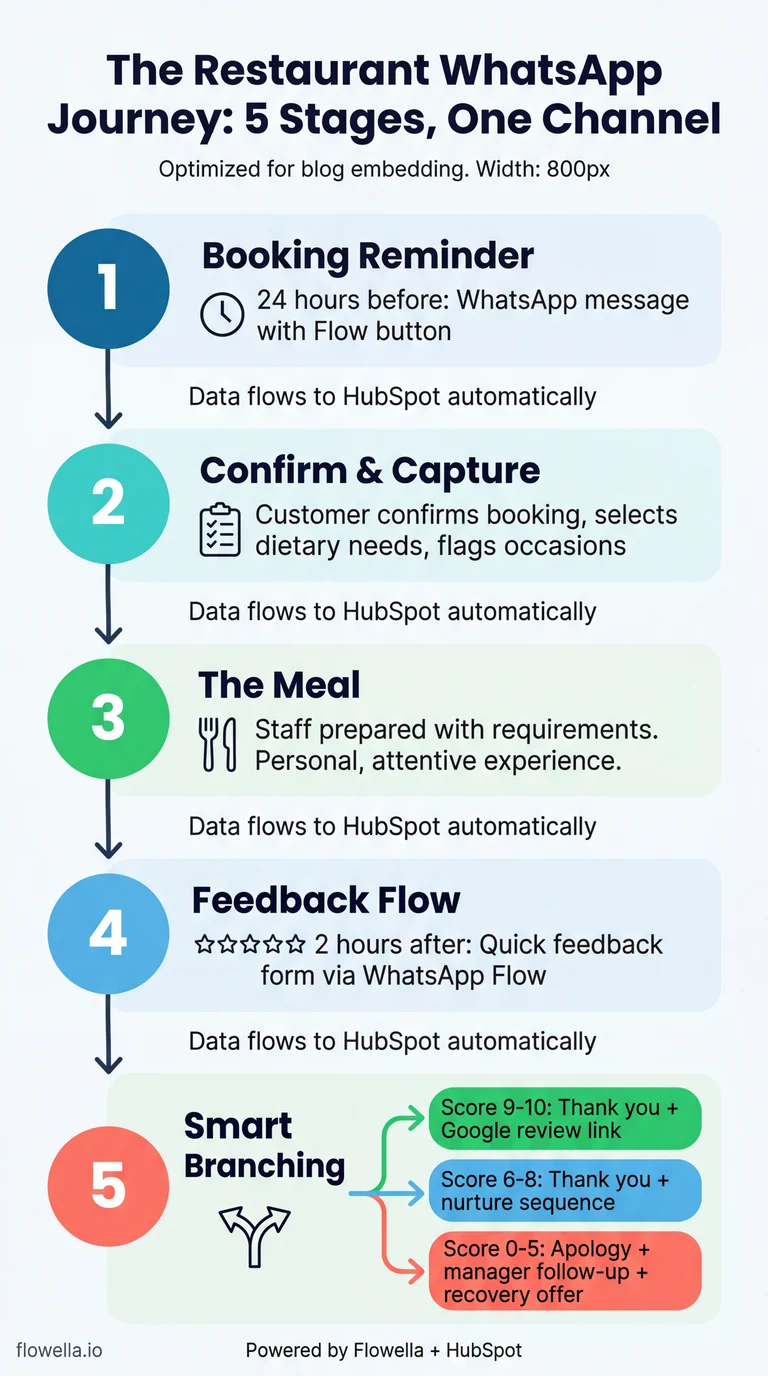
The journey: five stages, one channel
Here is how a restaurant can build an end-to-end customer workflow using Flowella, WhatsApp Flows and HubSpot. The entire experience happens inside WhatsApp; no phone calls, no emails, no back-and-forth.
Stage 1: Booking reminder (24 hours before)
The day before a reservation, the customer receives a WhatsApp message:
"Looking forward to seeing you tomorrow at 7pm. Tap below to confirm your booking and let us know about any requirements."
This is triggered by a HubSpot workflow, using the reservation date property on the contact record. The message includes a button that opens a WhatsApp Flow.
Stage 2: Confirmation and requirements capture
The customer taps the button and is presented with a short WhatsApp Flow, a guided form with structured fields:
- Confirmation: "Can you confirm your booking?" (Yes / I need to change it / Cancel)
- Dietary requirements: Multi-select dropdown (Vegetarian, Vegan, Gluten-free, Nut allergy, Dairy-free, No specific requirements)
- Special occasion: Optional dropdown (Birthday, Anniversary, Business dinner, Other)
- Additional notes: Optional free-text field
The customer completes this in seconds. No phone call. No email chain. Just a few taps and they are done.
What happens behind the scenes: The Flow submission writes directly back into HubSpot via Flowella. The contact record is updated with structured properties: booking confirmed (yes/no), dietary requirements (multi-value), special occasion (single value). A HubSpot workflow triggers automatically: if confirmed, the kitchen team receives a notification with dietary details. If a special occasion is flagged, the front-of-house manager gets an alert. See our HubSpot integration guide for the technical details.
Stage 3: The meal
The customer arrives, is greeted by staff who already know about their requirements and special occasion, and enjoys their meal. This is where the structured data pays off: the experience feels personal and attentive, because the information was captured cleanly and distributed to the right people in advance.
Stage 4: Post-meal feedback (2 hours after booking end time)
A couple of hours after the reservation time, the customer receives a second WhatsApp message:
"Thanks for dining with us tonight! We'd love to know how it went. Tap below to share your feedback; it only takes 30 seconds."
This opens a second WhatsApp Flow:
- Overall rating: 0 to 10 scale (or a simplified Low / Medium / High)
- What stood out? Multi-select (Food quality, Service, Atmosphere, Value for money)
- Any comments? Optional free-text
Stage 5: Intelligent branching based on the score
This is where structured data truly shines. Because the feedback score comes back as a numerical property in HubSpot, you can build branching logic that responds automatically:
| Score | Automatic Action | Business Outcome |
|---|---|---|
| 9 or 10 | Thank-you message + direct Google review link + optional referral code | More 5-star reviews, organic referrals |
| 6 to 8 | Warm thank-you + add to nurture sequence for future promotions | Repeat visits, increased lifetime value |
| 5 or below | Empathetic message + recovery Flow for more detail + HubSpot ticket for manager + optional discount | Service recovery before a negative review goes public |
Same channel. Same customer experience. Totally different outcomes, all based on structured inputs that flow through HubSpot's workflow engine without a single person needing to read a message manually.
Why this works better than the traditional approach
Compare this to how most restaurants handle the same journey today:
Traditional approach: Confirmation is done by phone (if at all). Dietary requirements are captured verbally and scribbled on a notepad. Feedback is a printed card on the table that gets filled in by maybe 5% of diners. Complaints surface on Google reviews weeks later, when it is too late to recover the relationship.
WhatsApp Flow approach: Confirmation, requirements, feedback and follow-up all happen in a channel the customer already checks dozens of times a day. Data is captured cleanly, acted on automatically and feeds into a system that learns and improves over time.
The Meta report's data backs this up. Consumers enjoy these interactions at rates above 90% in most cases. They are not tolerating automated messages; they actively prefer them to the alternatives.[1]
Beyond hospitality
While this restaurant example illustrates the concept clearly, the same pattern applies to any business that relies on confirmations, reminders, data collection or feedback. The Meta report's transactional enjoyment data spans well beyond hospitality:
- Booking appointments: 90.1% enjoyment
- Getting customer support: 90.2% enjoyment
- Shopping and buying: 87.5% enjoyment
- Banking and account management: 84.7% enjoyment
- Arranging returns: 87.3% enjoyment
Whether you are in financial services running KYC verification flows, in insurance refreshing contact details at renewal, in education collecting enrolment information, or in property management handling maintenance requests, the pattern is the same: send a structured Flow at the right moment, collect clean data, automate the next step.
Setting it up
If you are using HubSpot, building this kind of workflow with Flowella is straightforward. Our getting started guide walks you through the full setup, but here is the summary:
- Create your forms in HubSpot - one for booking confirmation and requirements, one for post-visit feedback
- Generate your WhatsApp Flows in Flowella - connect your HubSpot account, select the form, and Flowella generates a WhatsApp Flow template from it. You can tailor the wording, set required fields and define key branches
- Build the workflows in HubSpot - trigger the messages at the right moment: 24 hours before the reservation, 2 hours after it ends, and so on
When the customer completes the WhatsApp Flow, the submission is automatically written back into HubSpot. From there, HubSpot does what it does best: update the contact record, notify the team, send a coupon, open a ticket or kick off a longer nurture sequence.
And because the data is structured, the automation is reliable.
In the next article, we will tackle a question we hear often: if AI chatbots are getting so good, why bother with structured Flows at all? The answer, as the data shows, is more nuanced than you might think.
References
- Meta / Kantar: State of Business Messaging 2026 (online study of 11,056 adults across 22 global markets, April-September 2025)
Ready to build your first WhatsApp workflow? Start your free Flowella trial and have your first Flow running in under 30 minutes.