If your team answers customer questions on WhatsApp, the free lunch ends on 1 October 2026. From that date, Meta will charge for every message a business sends, including the replies inside the 24-hour customer service window that have been free since November 2024[1]. The WhatsApp pricing changes in October 2026 turn a habit most teams never think about, asking customers one question at a time, into a line on the invoice.
This post explains what is changing, when, and why the number of messages you send to collect a single piece of information is about to become your biggest cost driver. It then shows how WhatsApp Flows let you ask five, ten or twenty questions inside one message, and how Flowella writes the answers straight into HubSpot so you pay once and get clean data back.
What is changing in the WhatsApp pricing changes for October 2026
Meta moved the WhatsApp Business Platform from conversation-based pricing to per-message pricing on 1 July 2025[2]. Until now, that model has had a generous exception: any non-template message you send inside an open customer service window has been free, and so has any utility template sent inside that window.
Meta's non-template pricing page sets out the new timeline[1]:
| Date | What changes | How it is charged |
|---|---|---|
| 1 July 2026 | Meta Business Agent Platform launches | No charge yet |
| 1 August 2026 | Replies generated by Meta Business Agent become chargeable | Per token, $2.00 per million tokens, roughly 4 to 5 US cents per message |
| 1 October 2026 | Service messages (any human or third-party AI reply inside the 24-hour window) become chargeable | Per message, at the same rate as utility and authentication in that market, with no volume tiers |
| 1 October 2026 | Utility templates sent inside an open 24-hour window become chargeable | Per message, at the utility rate |
Two things stay the same. Inbound messages from customers remain free, and the 72-hour free entry point window that opens when someone messages you from a Click-to-WhatsApp ad or a Facebook call-to-action button is unchanged for message delivery[1]. Meta committed to publishing the rates that apply from 1 October by 1 September, so check the official rate card for your market before you budget.
Meta's own worked example
Meta illustrates the impact with a single one-hour interaction: a cart abandonment reminder, two AI answers to product questions, one reply from a human agent and an order confirmation.
In July 2026 that interaction incurred one charge, for the marketing template. From August it incurs three (one marketing, two Meta Business Agent). From 1 October it incurs five: one marketing, two Meta Business Agent, one service and one utility.
Same conversation, same customer, five times as many charges. The rate per message may be small, but the multiplier is what hurts.
Why per-message pricing punishes question-by-question data collection
Most WhatsApp chatbots and inbox workflows gather information the way a person would: one question, wait for the answer, next question. Name. Postcode. Budget. Preferred date. Best time to call. Consent. That is six business messages before a salesperson has anything useful, and from 1 October each one is a service charge[1].
If you have switched those replies to Meta Business Agent, the cost per message is higher still. Meta's estimate is around 20,000 to 25,000 tokens per message, so a simple "what time do you open" exchange comes to roughly 16 to 20 US cents and a ten-message support conversation to 40 to 50 cents[1].
There is a second cost that never appears on the Meta invoice. Free-text answers arrive as typos, half-answers and "yeah that one". Someone has to clean them before they are worth anything in the CRM. We covered why that matters for lead quality in The Real Problem with WhatsApp Chatbots.
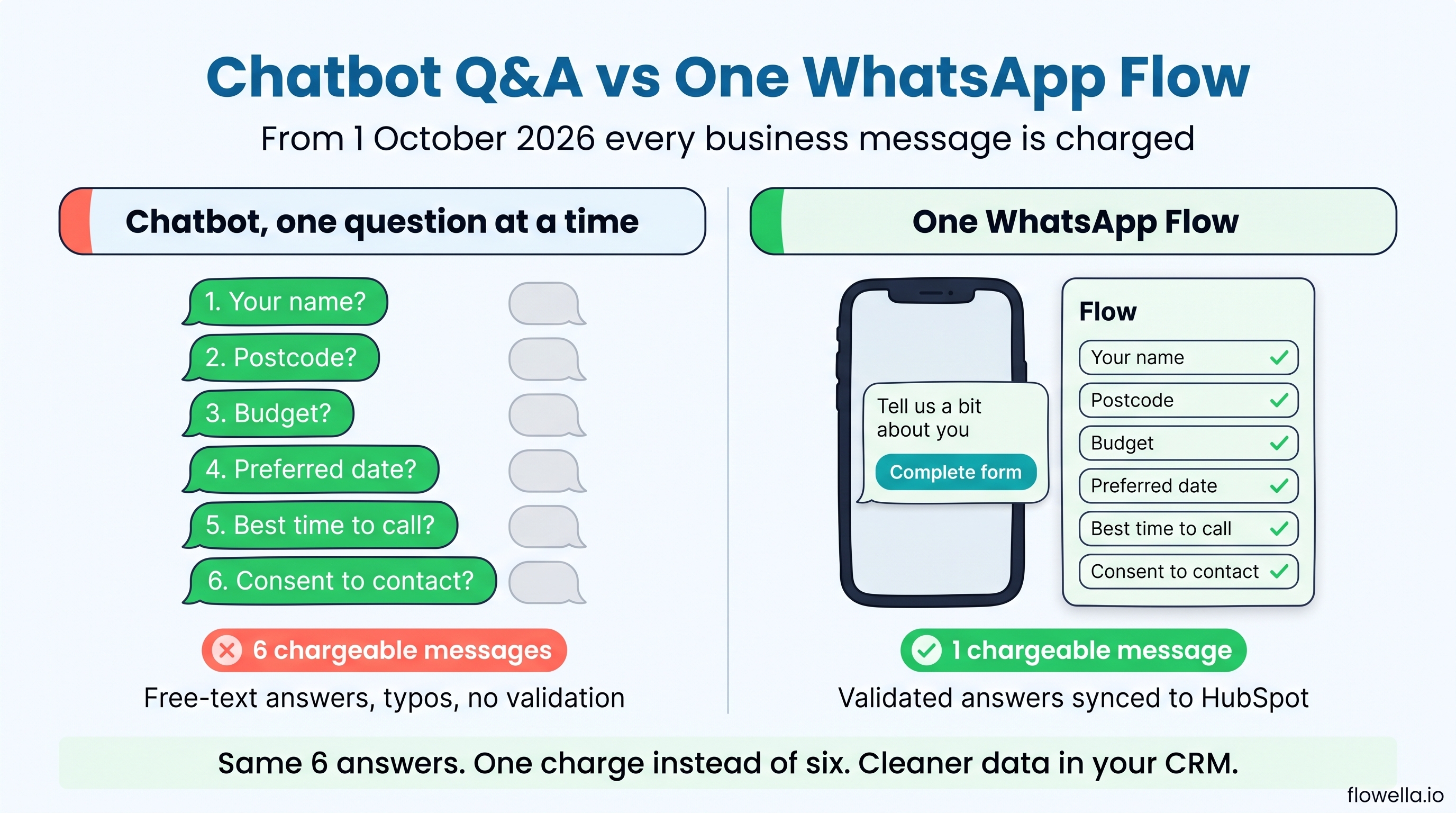
A worked comparison
Take a lead qualification exchange with six questions, sent to 5,000 contacts a month. Meta's own Brazil example uses a delivery rate of 0.68 US cents per service message and 2 to 9 cents per message for third-party AI on top[1]. The exact figures will differ by market, but the shape of the maths does not.
| Approach | Business messages per contact | Chargeable messages per month (5,000 contacts) | Data quality |
|---|---|---|---|
| Chatbot, one question at a time | 6 service messages | 30,000 | Free text, unvalidated |
| One WhatsApp Flow | 1 template message | 5,000 | Validated, mapped to CRM fields |
That is an 83 per cent reduction in chargeable messages before you count the AI cost you avoid, and before you count the hours nobody spends tidying up postcodes.
How WhatsApp Flows cut the message count to one
WhatsApp Flows are native, form-like screens that open inside the WhatsApp chat. Instead of a conversation, the customer sees a structured form with text fields, dropdowns, date pickers, checkboxes and multi-step screens with branching logic. They complete it, tap submit, and the whole response comes back to you at once.
From a pricing point of view, the important parts are:
- One message carries the whole form - a Flow is attached to a single template (or a single interactive message inside the service window). You pay for that one message, however many questions it contains.
- The completed form is an inbound message - the customer's submission comes back to you as a user message, and inbound messages are not charged[2].
- Validation happens on the customer's phone - required fields, email and phone formats, and date ranges are enforced before submission, so there is no second message asking them to try again.
- Branching replaces follow-up questions - a "How many people?" answer can reveal the right next screen without another billable round trip.
The lead capture and qualification workflow guide in the Flowella knowledge base shows this end to end: a short qualification form over WhatsApp, responses scored, high-fit leads routed to sales. Every question in that form rides on one template send.
Which template category should you use?
Sending a Flow outside the 24-hour window means sending a template, and the template's category sets the price[2]. A form that follows a customer action (confirming a booking, completing onboarding, collecting KYC documents) usually qualifies as utility, the cheaper category. A form sent to a cold list is marketing. The Flowella guide to pricing and conversation categories explains how Meta decides, and why a mis-categorised template can quietly change your unit cost mid-campaign.
If the customer messages you first, you can send the Flow as a reply inside the window. From 1 October that reply is one service charge, which is still one charge instead of six.
Flowella: your HubSpot form in, a WhatsApp Flow out, answers back in the CRM
Building Flows by hand means designing screens in Meta's Flow Builder, then writing something to catch the submission and push it into your CRM. Flowella removes both steps. It takes the HubSpot forms you already have and turns each one into a native WhatsApp Flow, keeping your field names, options and required flags[3].
When a customer submits the Flow, Flowella writes the answers to the matching HubSpot contact properties and logs a form submission on the timeline, so every workflow, list and report you already run on web form submissions works on WhatsApp submissions too. There is no export, no spreadsheet and no free-text parsing. If you have ever wondered whether HubSpot can send a WhatsApp confirmation after a form submission, this is the same plumbing running in the other direction.
In practice the cost-saving setup looks like this:
- Consolidate your questions - move every question your chatbot or inbox team asks in sequence into one HubSpot form. Flowella's form design best practices cover label limits and which question types render best on a phone.
- Sync the form - Flowella publishes it to Meta as a WhatsApp Flow from the Flows page.
- Attach it to one template - send the Flow from a HubSpot workflow, a bulk send or a Click-to-WhatsApp ad, so the Flow arrives in the message that starts the conversation.
- Let HubSpot do the rest - score, route and follow up on the submitted properties with the workflows you already use, as described in the HubSpot workflow actions guide.
Because the answers land as structured properties rather than chat transcripts, you also get the reporting your WhatsApp lead generation deserves: conversion by source, time to qualify, and cost per qualified lead, all inside HubSpot.
What to do before 1 October 2026
You have a few weeks. Here is the short list.
- Count your messages per conversation - pull a sample of last month's WhatsApp conversations and count business messages per contact. Anything above two is a candidate for a Flow.
- Check the new rates for your markets - Meta publishes rate cards by currency on the pricing page. Service messages will match the utility rate in each market[1].
- Review any AI agent you run on WhatsApp - whether it is Meta Business Agent or a third-party bot, every reply it sends is now a charge. Give it a Flow to hand out instead of a script of questions.
- Move sequential questions into forms - start with the highest-volume conversation type: lead qualification, appointment booking, or onboarding.
- Keep the free entry point working for you - conversations that start from Click-to-WhatsApp ads stay free for 72 hours[1]. Sending a Flow as the first reply inside that window costs nothing at all. The Click-to-WhatsApp ads guide shows how to trigger a Flow from a keyword.
- Watch your usage - Flowella's channel analytics break conversations down by Meta category, so you can see the mix that drives your Meta bill.
One message, every answer, straight into HubSpot
From 1 October 2026, every message your business sends on WhatsApp costs money. The businesses that feel it least will be the ones that stopped asking questions one at a time. A WhatsApp Flow gathers a whole form's worth of answers in a single chargeable message, validates them on the customer's phone, and with Flowella writes them directly into HubSpot properties. Fewer messages, lower Meta charges, and data your sales team can use the moment it arrives.
Start a free Flowella trial and turn your first HubSpot form into a WhatsApp Flow before the new pricing lands, or book a demo and we will walk through your highest-volume conversation with you.
References
- Meta for Developers: Pricing for non-template messages (upcoming updates effective 1 August and 1 October 2026)
- Meta for Developers: Pricing on the WhatsApp Business Platform (per-message pricing, template categories, free entry point windows)
- Flowella Knowledge Base: What is Flowella? HubSpot-powered WhatsApp Flows for marketers
- Flowella Knowledge Base: Pricing and WhatsApp conversation categories