I never expected managing AI to teach me something about myself. But after months of working with AI tools every day, building prompts, reviewing outputs, and refining instructions, I started to notice an uncomfortable pattern. The same problems I was having with AI were the same problems I had been creating for the people around me.
Vague briefs. Unclear expectations. Frustration when the result did not match the picture in my head. Sound familiar? It turns out that the skills required to get great results from AI are remarkably similar to the skills required to lead a team well. And for many of us, that realisation is both humbling and genuinely useful.
Why Managing AI Is Like Managing People
When you delegate a task to a colleague, the quality of the output depends heavily on the quality of the brief. Give someone a vague instruction and you get a vague result. The same is true for AI. According to McKinsey, effective human-AI interaction demands the same core competencies as people management: framing problems clearly, overseeing outputs, interpreting results, and managing exceptions[1].
Yet most of us skip these steps with AI just as we skip them with people. We fire off a quick prompt, hope for the best, and then blame the tool when it misses the mark. Research from Deloitte found that only 6% of organisations qualify as "AI high performers", and those top performers are three times more likely to have senior leaders actively driving AI strategy[2]. The difference is not better technology. It is better leadership.
The gap between AI success and AI disappointment is almost always a leadership gap, not a technology gap.
The Hard Truths About AI Output (and Your Briefing)
Here is a truth that stings: when AI produces poor output, it is usually reflecting a poor input. A study by the AI World Journal found that 77% of businesses are concerned about AI hallucinations and inaccurate outputs[3]. But hallucinations are not random. They happen most frequently when instructions are ambiguous, context is missing, or the desired outcome is not clearly defined.
Think about that in human terms. When a team member delivers something off-brief, the first question a good leader asks is: "Was my brief clear enough?" The same discipline applies to AI. Structured, specific instructions consistently produce better results than open-ended requests.
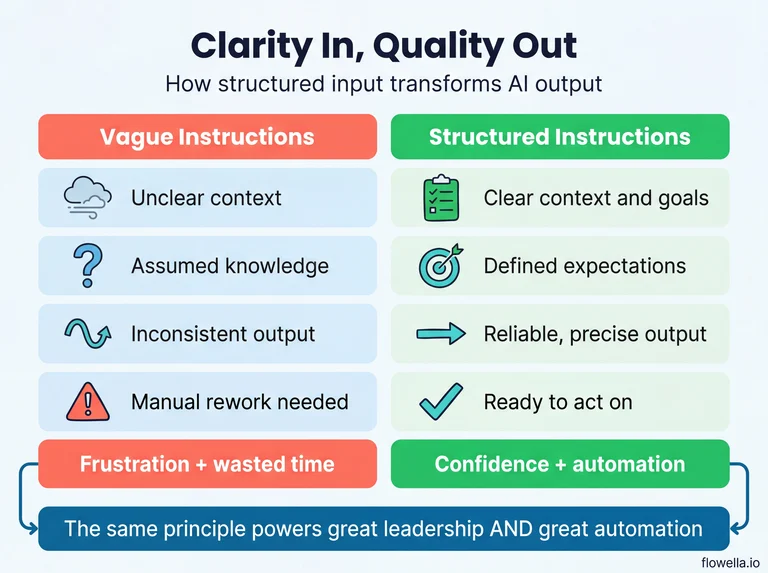
This is not about becoming a "prompt engineer". It is about becoming a clearer communicator. And that clarity benefits every interaction you have, whether with AI, with your team, or with your customers.
AI as a Mirror for Your Leadership Style
One of the most unexpected benefits of working closely with AI is that it holds up a mirror to your communication habits. AI does not fill in the gaps politely the way a colleague might. It does not assume what you probably meant. It takes your instructions at face value and delivers accordingly.
That brutal honesty is valuable. It exposed patterns in my own leadership that I had been blind to for years:
- Assuming context that was never shared - I would skip background information because it felt obvious to me, then wonder why the output missed the point
- Confusing activity with clarity - I would write long, detailed briefs that were actually disorganised, burying the key objective under layers of nice-to-haves
- Moving the goalposts - I would refine my expectations during the review rather than defining them upfront, creating a frustrating cycle of revisions
The Stanford AI Index 2025 reported that 76% of enterprises now include human-in-the-loop processes in their AI workflows[4]. That statistic underlines an important point: AI is not replacing human judgement. It is amplifying whatever judgement you bring to the table, good or bad.
Five AI Leadership Skills That Transfer Directly to People Management
Working with AI daily has sharpened five specific skills that have made me a measurably better leader:
- Defining the outcome before the process - AI forces you to state what "good" looks like before you start. This habit transforms how you set objectives for your team
- Providing structured context - Good AI prompts include role, audience, tone, format, and constraints. Good briefs for humans should include the same elements
- Reviewing critically without rewriting - AI taught me to give specific, actionable feedback ("make the introduction more concise") rather than vague reactions ("this does not feel right")
- Iterating quickly instead of expecting perfection - The best AI workflows involve rapid cycles of review and refinement. Applying this to team projects reduces bottlenecks and improves morale
- Documenting what works - When an AI prompt produces great results, you save it. When a process works well with your team, you should document that too
Gartner reported that 91% of service leaders feel pressured to implement AI, yet many lack the foundational skills to do so effectively[5]. The irony is that those foundational skills are not technical. They are leadership skills: clear communication, structured thinking, and consistent feedback loops.
From Personal Insight to Business Automation
This lesson does not just apply to one-on-one interactions with ChatGPT or Claude. It scales directly to how businesses automate their customer interactions. Consider how most companies handle customer enquiries on WhatsApp today: they deploy a chatbot with open-ended, conversational AI and hope for the best. The result? Inconsistent data, frustrated customers, and a support team cleaning up the mess.
The alternative is structured AI instructions applied at scale. Instead of asking customers open-ended questions, you guide them through a defined flow with clear options, validated inputs, and predictable outcomes. This is exactly the approach behind Flowella's WhatsApp Flows, where structured forms replace free-text chaos.
The parallel to leadership is direct. Just as a well-briefed team member delivers better work, a well-structured WhatsApp Flow delivers better customer data. The same principle that makes you a better leader also makes your business processes more reliable. And when that structured data flows straight into your CRM, the benefits compound. No manual data entry, no interpretation errors, just clean data from chat to CRM.
| Approach | Open-Ended AI Chat | Structured WhatsApp Flows |
|---|---|---|
| Customer experience | Unpredictable, often frustrating | Guided, clear, and fast |
| Data quality | Unstructured free text | Validated, structured fields |
| CRM integration | Manual extraction required | Automatic, real-time sync |
| Team workload | High (reviewing, correcting) | Low (exceptions only) |
| Scalability | Degrades with volume | Consistent at any scale |
The Leadership Lesson AI Keeps Teaching
The most valuable thing managing AI has taught me is this: clarity is kindness. Whether you are briefing an AI tool, delegating to a team member, or designing a customer journey, the effort you invest in being clear upfront saves everyone time, frustration, and wasted energy downstream.
With 59% of enterprise leaders reporting a significant AI skills gap in their organisations[6], the temptation is to treat this as a training problem. Buy more courses, hire more specialists, invest in more tools. But the real gap is not technical knowledge. It is the willingness to examine how we communicate, how we lead, and how we structure the work we ask others (human or artificial) to do.
AI did not make me a better leader by giving me answers. It made me a better leader by forcing me to ask better questions. And if you are building customer-facing automations, that same principle will determine whether your WhatsApp Flows feel like a helpful conversation or an exercise in frustration. Start with clarity, and the technology will follow.
References
- McKinsey: Superagency in the Workplace - Empowering People to Unlock AI's Full Potential
- Deloitte: State of Generative AI in the Enterprise (Q1 2025)
- AI World Journal: AI Adoption Statistics 2025
- Stanford University: AI Index Report 2025
- Gartner: 91% of Service Leaders Feel Urgency to Act on AI (February 2026)
- DataCamp: Top AI Statistics for 2026
Ready to apply structured thinking to your customer interactions?
Try Flowella free and turn your forms into guided WhatsApp Flows in minutes.
Get Started Free